.jpg)
Mastering Food and Garden Waste: Tŷ Hafan’s Experience with the Eco220 Composter
Learn how Tŷ Hafan uses the Biolan eco220 hot composter to recycle food waste on-site, reduce costs, and nourish hospice gardens year-round.
With businesses and domestic properties now compulsorily expected to recycle food waste, volunteer gardeners at the Tŷ Hafan Children’s Hospice started to research how they could accomplish recycling food on site into their gardening process, reducing food waste costs and also enriching their own gardens with free organic waste materials. After deciding a hot composter would be their best option, they contacted The Greenfingers Charity for support.
Greenfingers, whose crucial work provided hands-on garden creation for life limited children, contacted Plastic Solutions , the UK distributor of Biolan composting products, who provided a Biolan eco220 ‘hot composter’. The team at Tŷ Hafan spent 6 months integrating the Biolan eco220 into their daily routine. And then, Plastic Solutions made a site visit to answer operational questions to see how the composter has made a positive difference.
A little bit about the unit:
Technical Specifications of the Biolan eco220
Designed for efficient, year-round organic waste management, the eco220 incorporates advanced thermal engineering features to do so much more than the average compost heap could ever do:
Polyurethane Insulation:
High-quality insulation across the body, base, and hinged cover to maintain active internal core temperatures (reaching 50°C to 60°C) even during colder months.
Advanced Ventilation & Air Distribution:
Patented internal air channels direct oxygen straight to the centre of the compost mass, ensuring a fast decomposition period with minimal to no manual turning required.
Pest-Resistant
With food scraps in mind, moulded sealing strips on the lid and lower emptying door combine with a secure base to keep pests like rats completely locked out.
Odour Control
Bulking material created specifically for the unit helps to balance dry and wet waste to eliminate smells and provide the mass with the correct conditions to decompose effectively, whilst eliminating odours.
Seepage Liquid Management:
Equipped with an internal liquid separation plate and a rear outlet point (compatible with a 16 mm hose) to drain excess moisture allowing safe absorption directly into the soil.
Practical Learnings and Best Practices
Through hands-on experience, the dedicated volunteers of the Tŷ Hafan gardening team refined their operational approach:
Kitchen to Garden
Continual communication between the kitchen staff and garden volunteers ensures that everyone knows what’s being collected, when, and who’s is dealing with it. This means that with a ‘dry’ food collection additional moisture can be added, and on a ‘wet’ food day, suitable browns or bulking materials are added to ensure a consistent composting mixture is ‘fed’ into the composting bin.
Getting this balance right is essential to producing an odour free,pleasant, ‘sand’ type consistency compost at the end of the process.
Volunteer Deidre, who oversees when and how to ‘feed’ the composter, said that it has been a bit of a trial-and-error learning period. She pointed out that they discovered large meat bones for example can be hard to decompose in the composter and so these are generally avoided.
Gardening volunteer Tracey added:
“We put in everything from baked beans and eggs, vegetable peelings, cold food and plate scraps.
We talk to the kitchens regularly and make adjustments, [having the composter] is like having a baby to look after. We need to know what’s coming up [on the menu] and how we’re going to manage it within the composter”.
Pre-Mixing in Wheelbarrows:
Rather than strictly vertical layering, pre-mixing food waste with shredded office paper, and bulking material in a wheelbarrow achieved a superior, balanced consistency allowing decomposition to happen with minimal smell.
The mixture had previously been too wet, hindering decomposition and producing an unpleasant odour. However, after a visit from the Plastic Solutions team this was easily remedied.
Moisture and Bulking Material Control:
High-moisture food waste requires carbon-rich "browns" and bulking material (such as the 35-litre bags supplied with the unit) to prevent the bin from becoming overly wet and heavy.
Harvesting Rich Output:
Using the lower access door, mature compost can be easily retrieved. Because the thermal output is exceptionally concentrated, the team blends it into their open-air compost bays to mellow before applying it to their gardens.
For organisations looking for reliable organic waste solutions, units like the Biolan eco220 prove that professional-grade thermal composting successfully handles large scale kitchen waste.
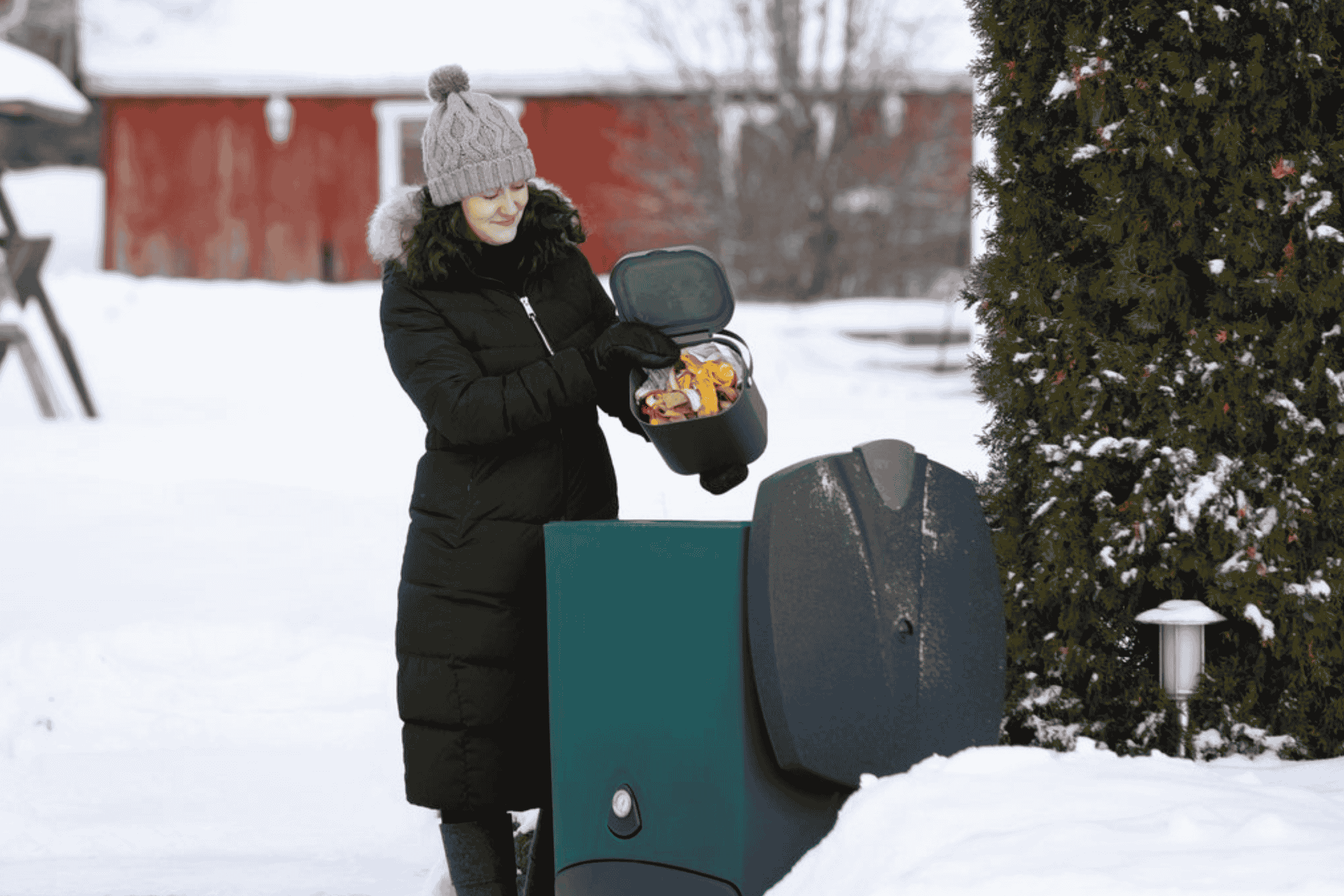
Winter Maintenance and Cold-Weather Operation
Maintaining consistent thermal performance during colder months is a common concern when operating outdoor composters. Because the Biolan eco220 is engineered with an insulated body, it retains core heat remarkably well even when ambient temperatures drop below freezing. It is made in Finland, after all, and they know a thing or two about the cold.
Key Tips for Winter Composting Success
Increase Waste Volume:
During winter, biological activity naturally slows down. Adding waste more regularly in smaller, consistent amounts helps maintain the internal heat generated microbes in the unit.
Adjust the Air Valve:
Monitor the built-in temperature gauge and adjustthe ventilation valve accordingly. Reducing airflow in freezing weather helpstrap warmth inside the composting mass.
Keep Extra Bulking Material Indoors:
Store your carbon-rich bulking material bags (such as fine bark or dry shredded paper) inside a shed or utility room so they stay dry and do not introduce frozen moisture into the chamber.
FAQs
What is the Biolan eco220 hot composter and how does it work?
Advanced Thermal Composting Mechanics
· The Biolan eco220 is a thermal composter that relies on aerobic (oxygenated) decomposition, utilising an insulated polyurethane between the unit’s double-skinned shell to maintain active internal core temperatures between 10°C and 60°C.
· It features patented internal air distribution channels that direct oxygen straight to the centre of the compost mass, ensuring optimal breakdown with minimal manual turning.
Can you put cooked food and kitchen waste in the Biolan eco220?
Safe Management of Kitchen Scraps
· Yes. Unlike traditional open compost heaps that must be restricted to raw vegetable peelings to avoid pests, the sealed 220-litre unit securely processes cooked foods, fruit and vegetables, dairy products and many other food items.
· Large bones and thick woody twigs should be avoided or cut up into small chunks as they take much longer to process.
How do you prevent odours and excess moisture in the composter?
Controlling Moisture and Carbon Ratios
· High-moisture food waste can cause the bin to become overly wet and produce odours.
· To prevent this, users should mix food waste with carbon-rich "browns" such as specialised fine bark bulking material (initial bag provided with the unit and can be re-supplied by Plastic Solutions) or shredded office paper and dry leaves.
The gardeners at Tŷ Hafan found pre-mixing materials in a wheelbarrow before adding them to the composter ensures an ideal consistency certainly in the early stages of using the unit.
How long does it take to produce finished compost?
Rapid Processing Times
· Under optimal operating temperatures (around 50°C to 60°C), the composter can produce ready-to-harvest compost within approximately 6 weeks.
· Mature compost is easily accessed via the lower access hatch. Because the thermal output is exceptionally concentrated and rich, it can be blended with open compost bays before applying it to flower beds, although this is not always necessary.
Does the unit attract pests like rats?
Pest-Resistant Design
· No. The unit features moulded sealing strips on the lid and lower emptying door combined with a secure, sealed base, keeping pests completely locked out. This makes it safe to install on-site at commercial, educational, or health care facilities where open heaps would definitely pose a rodent risk.
How is excess liquid managed?
Built-in Liquid Separation
· If there is too much liquid in the system, the composter is equipped with an internal liquid separation system and a rear outlet point(compatible with a 16 mm hose) that allows excess moisture to be drained or safely absorbed directly into the soil.
If you would like to know ore about how the internal mechanism of the Biolan eco220unit work, then read our blogs
OTHER POSTS IN THIS CATEGORY:
Learn how Tŷ Hafan uses the Biolan eco220 hot composter to recycle food waste on-site, reduce costs, and nourish hospice gardens year-round.

.jpg)
Discover 10 practical ways to reuse filtered greywater safely for gardens, toilet flushing, composting and off-grid living.
.jpg)
How a Bristol community eliminated commercial waste fees turning 4.5 tonnes of food scraps into rich compost in 6 weeks with a Biolan hot composter
.jpg)
Duckling Barn Glamping needed off-grid, eco-friendly sanitation. A 200L composting toilet offered a waterless, odourless, sustainable solution.

.png)
The Biolan 220eco composter handles all food waste, including cooked scraps, all winter. Use bulking material for perfect, odour-free compost

Yes, you can compost in winter! Learn how to keep your bin active during the UK's cold months with tips, tools, and winter-ready composters.

SEARCH BY AUTHOR:
